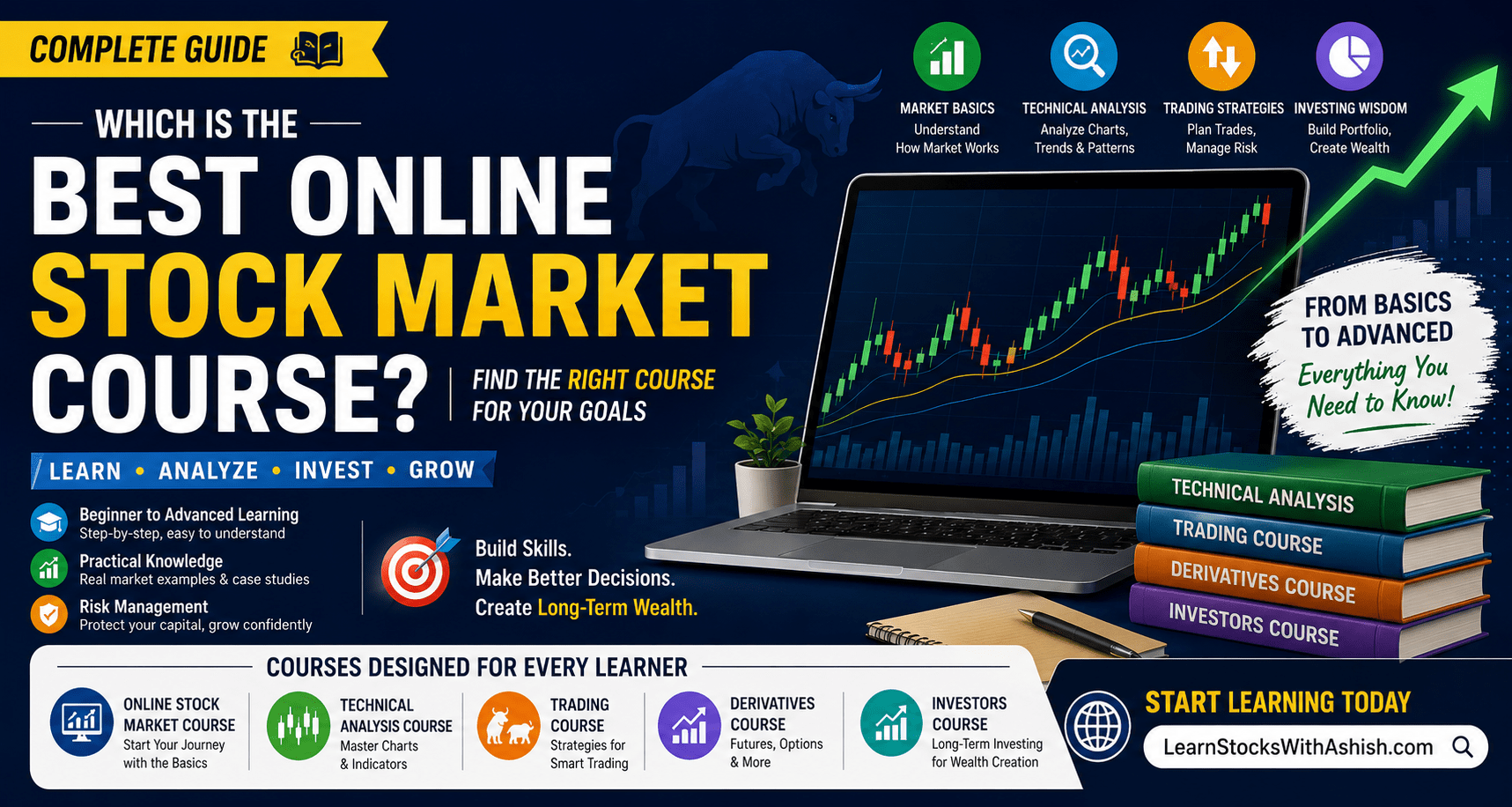
A Complete Guide to Choosing the Right Online Stock Market Course
The stock market has become one of the most popular ways to participate in the growth of businesses and build long-term wealth. With more people opening Demat accounts and taking an interest in investing, the demand for quality financial education has grown rapidly.
At the same time, the internet is filled with videos, blogs, social media posts, and countless online courses. While having so many learning options is helpful, it can also make it difficult to decide where to begin. A course may promise quick success, but what truly matters is whether it helps learners build a solid understanding of the market through structured, practical education.
If you’re searching for an Online Stock Market Course, it’s worth taking the time to compare different learning platforms based on their curriculum, teaching approach, practical exposure, and long-term value. One platform that offers a structured path for learners is LearnStocksWithAshish.com, with dedicated courses covering technical analysis, trading, derivatives, and investing.
This guide explains what to look for in a quality stock market course and how a well-planned learning journey can help you develop confidence before participating in the financial markets.
Why Learning the Stock Market Matters
Many people begin investing after hearing about market opportunities from friends, family, or social media. While curiosity is a great starting point, making investment decisions without understanding the fundamentals can increase the likelihood of avoidable mistakes.
Learning the stock market is about much more than understanding charts or tracking prices. It involves developing the ability to evaluate businesses, understand market trends, manage risk, and make informed financial decisions.
A structured learning program can help you understand topics such as:
- How the stock market works
- The role of stock exchanges
- Fundamental analysis
- Technical analysis
- Trading psychology
- Risk management
- Portfolio diversification
- Long-term investing principles
- Market cycles and investor behavior
Rather than relying on opinions, you learn how to analyze opportunities using established concepts and practical techniques.
What Makes a Good Online Stock Market Course?
Not every course offers the same learning experience. Some focus only on theory, while others emphasize practical application. Choosing the right course depends on your goals and the quality of the curriculum.
Here are some important factors to consider before enrolling.
1. A Well-Structured Curriculum
The learning journey should progress logically from basic concepts to more advanced topics.
A beginner should first understand how the stock market functions before moving on to chart analysis, derivatives, or advanced trading strategies.
A structured curriculum makes learning easier and reduces confusion.
2. Practical Learning
Financial markets cannot be understood through theory alone.
A valuable course should include practical examples such as:
- Live market observations
- Chart analysis
- Company research
- Market case studies
- Portfolio discussions
- Real-world scenarios
Practical learning helps learners connect concepts with actual market situations.
3. Easy-to-Understand Explanations
Financial concepts often appear complicated when explained using technical jargon.
Good educators simplify complex ideas using clear language, relatable examples, and step-by-step explanations so that beginners can build confidence gradually.
4. Updated Content
Markets evolve continuously.
Changes in regulations, technology, economic conditions, and financial products mean educational content should be reviewed and updated regularly to remain relevant.
5. Focus on Risk Management
One of the most valuable lessons any investor can learn is that preserving capital is just as important as seeking returns.
A comprehensive Online Stock Market Course should include topics such as:
- Position sizing
- Diversification
- Risk-reward concepts
- Emotional discipline
- Portfolio allocation
These principles can help learners develop a balanced approach to investing.
Why Consider LearnStocksWithAshish.com?
When evaluating online learning platforms, many learners look for a program that combines structured lessons with practical market education.
LearnStocksWithAshish.com is designed to support learners at different stages of their stock market journey. Instead of focusing on a single topic, the platform offers specialized courses that cover multiple aspects of market education.
Its learning approach emphasizes understanding concepts before applying them, helping learners build confidence step by step.
The platform includes courses in:
- Online Stock Market Course
- Technical Analysis Course
- Trading Course
- Derivatives Course
- Investors Course
This variety allows learners to choose a path based on their current knowledge and future goals.
Courses Offered by LearnStocksWithAshish.com
Online Stock Market Course
This course is suitable for individuals who want to understand the stock market from the ground up.
It introduces essential concepts such as:
- How the stock market works
- Market participants
- Stock exchanges
- Demat and Trading Accounts
- Investment fundamentals
- Market terminology
- Basic analysis techniques
- Introduction to risk management
For beginners, this course can serve as the foundation for further learning.
Technical analysis is widely used to study price movements and market trends.
The Technical Analysis Course focuses on topics including:
- Candlestick patterns
- Support and resistance
- Trend identification
- Moving averages
- RSI
- MACD
- Chart patterns
- Volume analysis
These concepts can help learners understand how traders interpret market behavior using charts and indicators.
Trading requires discipline, planning, and a clear understanding of market dynamics.
The Trading Course explores topics such as:
- Trading strategies
- Market structure
- Entry and exit planning
- Risk management principles
- Trade planning
- Market psychology
The emphasis is on building a systematic approach rather than relying on speculation.
Derivatives are financial instruments whose value is linked to an underlying asset.
This course introduces learners to concepts such as:
- Futures
- Options
- Contract specifications
- Hedging concepts
- Market mechanics
- Basic derivatives strategies
- Risk considerations
Because derivatives involve additional complexity, understanding the fundamentals is an important first step.
Long-term investing often requires a different mindset than short-term trading.
The Investors Course focuses on developing knowledge related to:
- Business analysis
- Financial statement interpretation
- Company evaluation
- Portfolio construction
- Long-term investment principles
- Wealth creation strategies
- Diversification
This course is designed for learners who are interested in understanding businesses and making informed investment decisions over time.
Who Can Benefit from These Courses?
Stock market education is not limited to finance professionals.
These courses may be useful for:
- Beginners exploring investing for the first time
- College students interested in financial markets
- Working professionals seeking financial knowledge
- Entrepreneurs wanting to understand investments
- Long-term investors looking to strengthen their research skills
- Individuals preparing to participate in the equity market
Since the courses are offered online, learners can study from home at their own pace.
Learning Online: Flexibility and Convenience
One of the biggest advantages of an Online Stock Market Course is the flexibility it offers.
Learners can often:
- Study according to their own schedule
- Revisit lessons when needed
- Learn from any location with internet access
- Progress through topics step by step
- Balance learning with work or education
This flexibility makes online education suitable for individuals with different schedules and commitments.
Building Confidence Through Knowledge
Every successful investor starts as a beginner.
The difference often lies in the willingness to learn before making financial decisions.
By understanding market fundamentals, learning analytical techniques, and developing disciplined habits, learners can approach the market with greater confidence and clarity.
Educational platforms such as LearnStocksWithAshish.com aim to provide structured learning resources that help individuals build a stronger foundation in stock market concepts before applying that knowledge in real-world situations.
Learning the Stock Market Is a Journey, Not a One-Day Process
Every experienced investor or trader started with the same basic questions:
- How does the stock market work?
- Which shares should I buy?
- How do professionals analyze stocks?
- What causes prices to rise and fall?
- How can I reduce investment risk?
The answers don’t come from shortcuts. They come from learning, observing the market, practicing, and continuously improving.
A well-designed Online Stock Market Course helps learners build this knowledge step by step instead of overwhelming them with advanced concepts from the beginning.
At LearnStocksWithAshish.com, the courses are organized to help learners gradually understand different areas of the stock market, from the basics of investing to technical analysis and derivatives.
What You’ll Learn in the Online Stock Market Course
The Online Stock Market Course is designed for people who are starting their journey in the financial markets.
Instead of assuming prior knowledge, it begins with the fundamentals and gradually introduces more advanced topics.
Some of the major topics include:
Understanding the Stock Market
You’ll learn:
- What is the stock market?
- Why companies issue shares
- How investors participate
- Role of stock exchanges
- How buying and selling takes place
Understanding these concepts creates a strong foundation before moving toward analysis or trading strategies.
Understanding Demat and Trading Accounts
Every investor should understand:
- How a Demat Account works
- Purpose of a Trading Account
- Settlement process
- Order execution
- Brokerage charges
- Different order types
These practical topics help beginners understand the complete investment process.
Understanding Market Participants
Markets involve different participants, including:
- Retail Investors
- Institutional Investors
- Mutual Funds
- Foreign Investors
- Domestic Institutional Investors
- Brokers
- Market Regulators
Knowing who participates in the market helps learners understand why prices fluctuate.
Market Cycles
No market moves upward forever.
The course explains:
- Bull Markets
- Bear Markets
- Market Corrections
- Consolidation
- Recovery Cycles
Understanding these phases helps investors maintain realistic expectations.
Technical Analysis Course
Technical Analysis is one of the most popular methods used to study price movement.
Instead of predicting the future, it helps traders interpret market behavior based on historical price data and trading activity.
The Technical Analysis Course focuses on building practical chart-reading skills.
Candlestick Analysis
Candlesticks provide important information about market sentiment.
Learners understand patterns such as:
- Doji
- Hammer
- Shooting Star
- Engulfing Pattern
- Morning Star
- Evening Star
- Marubozu
Rather than memorizing patterns, learners understand the psychology behind them.
Support and Resistance
Support and Resistance are fundamental concepts in technical analysis.
The course explains:
- Why prices stop falling
- Why prices reverse
- Important buying zones
- Potential selling zones
- Price reactions
These concepts are widely used by both traders and investors.
Trend Analysis
Markets generally move in trends.
The course explains:
- Uptrend
- Downtrend
- Sideways Market
- Trend Reversal
- Trend Continuation
Understanding trends helps learners interpret market direction more effectively.
Technical Indicators
Indicators are tools that assist in market analysis.
Topics include:
- Relative Strength Index (RSI)
- MACD
- Moving Averages
- Bollinger Bands
- Volume Analysis
Rather than depending on a single indicator, learners understand how different tools can complement each other.
Trading Course
Trading requires planning, discipline, and consistency.
The Trading Course focuses on helping learners understand the decision-making process behind trades rather than encouraging impulsive buying or selling.
Trading Psychology
One of the biggest challenges in trading is controlling emotions.
The course discusses topics such as:
- Fear
- Greed
- Overconfidence
- Patience
- Discipline
- Decision-making under pressure
Developing the right mindset is an important part of becoming a disciplined trader.
Trade Planning
Before entering any trade, several factors should be considered.
The course explains:
- Entry planning
- Exit planning
- Risk assessment
- Reward expectations
- Position sizing
Having a plan before entering the market can improve consistency.
Capital Management
Managing capital is just as important as identifying opportunities.
Topics include:
- Risk per trade
- Portfolio allocation
- Exposure management
- Drawdown control
Protecting capital is a key principle in long-term market participation.
Derivatives Course
Derivatives are commonly used for hedging, speculation, and managing market exposure.
Because these instruments involve additional complexity, understanding their mechanics is essential before using them.
The Derivatives Course introduces learners to the fundamentals.
Futures
Topics include:
- Futures contracts
- Lot sizes
- Margin requirements
- Expiry dates
- Mark-to-market settlement
Learners understand how futures function within the financial markets.
Options
The course introduces concepts including:
- Call Options
- Put Options
- Strike Price
- Premium
- Expiry
- Intrinsic Value
- Time Value
These topics help learners understand the building blocks of options trading.
Understanding Risk in Derivatives
The course also emphasizes that derivatives involve unique risks.
Topics include:
- Leverage
- Time decay
- Volatility
- Margin considerations
- Position management
Understanding these concepts helps learners appreciate the importance of disciplined decision-making.
Investors Course
Not everyone wants to trade frequently.
Many individuals are more interested in identifying quality businesses and holding investments over the long term.
The Investors Course focuses on this approach.
Understanding Businesses
Learners study how businesses operate.
Topics include:
- Revenue
- Profitability
- Business models
- Competitive advantages
- Industry analysis
- Growth opportunities
Financial Statement Analysis
The course introduces important financial documents such as:
- Balance Sheet
- Profit & Loss Statement
- Cash Flow Statement
Understanding these reports helps investors evaluate companies more effectively.
Fundamental Ratios
Important financial metrics include:
- Earnings Per Share (EPS)
- Price-to-Earnings Ratio (P/E)
- Return on Equity (ROE)
- Debt-to-Equity Ratio
- Return on Capital Employed (ROCE)
Rather than memorizing numbers, learners understand what these ratios indicate about a business.
Practical Learning Makes the Difference
Watching videos alone is rarely enough to develop market knowledge.
Practical learning helps bridge the gap between theory and real-world application.
A structured learning experience often includes:
- Market examples
- Historical chart analysis
- Company research
- Financial statement discussions
- Investment case studies
- Market observations
Learning concepts alongside practical illustrations helps learners build confidence over time.
Common Mistakes Beginners Make
Every new investor is likely to make mistakes. Understanding them early can help reduce avoidable errors.
Following Social Media Tips
Market decisions should be based on research rather than unverified opinions.
Ignoring Risk
Investing without understanding risk can expose capital to unnecessary volatility.
Chasing Quick Profits
Long-term consistency is generally more sustainable than attempting to capture every short-term market movement.
Investing Without Learning
Knowledge often becomes one of the most valuable investments a person can make before participating in financial markets.
A structured Online Stock Market Course provides a systematic way to build that foundation.
Benefits of Structured Learning
A structured curriculum offers several advantages over random online content.
It helps learners:
- Progress logically
- Avoid information overload
- Build confidence gradually
- Understand relationships between concepts
- Develop analytical thinking
- Learn at their own pace
Instead of searching for scattered information, learners follow a clear roadmap.
Why Continuous Learning Matters
The financial markets continue to evolve.
New industries emerge.
Economic conditions change.
Regulations are updated.
Technology transforms the way markets operate.
For this reason, successful investors and traders continue learning throughout their journey.
Building knowledge is an ongoing process rather than a one-time event.
Choose the Right Course, Build Confidence, and Keep Learning
How to Choose the Right Stock Market Course for Your Goals
One of the most common questions beginners ask is: “Which stock market course should I start with?”
The answer depends on your objective. Different learners join the market for different reasons.
Some want to build long-term wealth through investing, while others want to understand chart analysis, trading strategies, or derivatives.
Before enrolling in any Online Stock Market Course, identify your primary goal.
If Your Goal Is to Understand the Basics
Start with a beginner-focused Online Stock Market Course.
This helps you learn:
- How the stock market works
- What is a Demat Account?
- What is a Trading Account?
- How shares are bought and sold
- Basic market terminology
- Introduction to risk management
Building a strong foundation first makes advanced topics easier to understand later.
If Your Goal Is Chart Analysis
Choose a Technical Analysis Course.
This path is suitable for learners who want to understand:
- Candlestick patterns
- Support and resistance
- Trend analysis
- Moving averages
- RSI and MACD
- Price action concepts
Technical analysis can be useful for both traders and investors who want better entry and exit timing.
If Your Goal Is Active Trading
A dedicated Trading Course may be the better choice.
This type of course focuses on:
- Trade planning
- Risk management
- Position sizing
- Trading psychology
- Entry and exit strategies
- Market discipline
Many beginners discover that discipline and risk control are just as important as finding trading opportunities.
If Your Goal Is Derivatives
A Derivatives Course is suitable for learners who want to understand:
- Futures contracts
- Options basics
- Strike prices
- Premiums
- Expiry
- Hedging concepts
- Options strategies
Because derivatives involve additional complexity, many learners first complete a foundational stock market course before moving to derivatives.
If Your Goal Is Long-Term Investing
An Investors Course is often the most relevant option.
This learning path focuses on:
- Business analysis
- Financial statements
- Fundamental ratios
- Portfolio construction
- Long-term wealth creation
- Diversification principles
This approach is generally preferred by people who want to build investments over several years rather than trade frequently.
Why Structured Learning Often Saves Time
Many beginners spend months watching random videos and reading scattered articles. While free resources can be helpful, they often lack a clear sequence.
A structured learning program helps you:
- Learn concepts in the right order
- Avoid information overload
- Connect theory with practical examples
- Build confidence gradually
- Develop a consistent learning routine
This is one reason many learners prefer a complete Online Stock Market Course instead of collecting information from multiple unrelated sources.
What Makes LearnStocksWithAshish.com Different?
When evaluating stock market education platforms, learners often look for three things:
1. Structured Curriculum
Lessons progress from beginner concepts to more advanced topics.
2. Practical Market Learning
Concepts are easier to understand when explained with real market examples.
3. Multiple Learning Paths
Not every learner has the same goal. Some want to invest, some want to trade, and others want to learn derivatives.
LearnStocksWithAshish.com offers dedicated courses for different learning objectives, including:
- Online Stock Market Course
- Technical Analysis Course
- Trading Course
- Derivatives Course
- Investors Course
This allows learners to choose a course that matches their current knowledge level and future goals.
Frequently Asked Questions (FAQs)
1. Which course is best for complete beginners?
A beginner should generally start with a foundational Online Stock Market Course that explains market basics before moving to advanced topics.
2. Do I need a finance background to learn the stock market?
No. Most stock market courses are designed for learners from different educational and professional backgrounds.
3. Can I learn stock market trading online?
Yes. Online learning platforms provide access to lessons, charts, case studies, and practical examples that can help learners understand trading concepts.
4. What is the difference between investing and trading?
Investing usually focuses on long-term wealth creation, while trading generally involves shorter-term buying and selling decisions.
5. Is technical analysis useful for investors?
Many investors use technical analysis to improve their timing for buying or selling investments.
6. What will I learn in a Technical Analysis Course?
Common topics include candlestick patterns, support and resistance, trends, moving averages, RSI, MACD, and chart analysis.
7. What is covered in a Derivatives Course?
A Derivatives Course typically introduces futures, options, strike prices, premiums, expiry, and basic derivatives strategies.
8. Is stock market learning useful even if I don’t trade?
Yes. Understanding the stock market can help you make more informed investment and financial decisions.
9. How long does it take to learn the stock market?
Learning is an ongoing process. Basic concepts can often be understood within weeks, while advanced skills develop through continuous study and market observation.
10. Does any course guarantee profits?
No. Educational courses provide knowledge and skills, but market outcomes depend on research, discipline, risk management, and market conditions.
Why Continuous Learning Matters
The financial markets change constantly.
New industries emerge. Economic conditions shift. Regulations evolve. Technology changes the way markets operate.
For this reason, successful investors and traders continue learning throughout their journey.
Whether you begin with an Online Stock Market Course, a Technical Analysis Course, or an Investors Course, the most important step is developing a habit of continuous learning.